
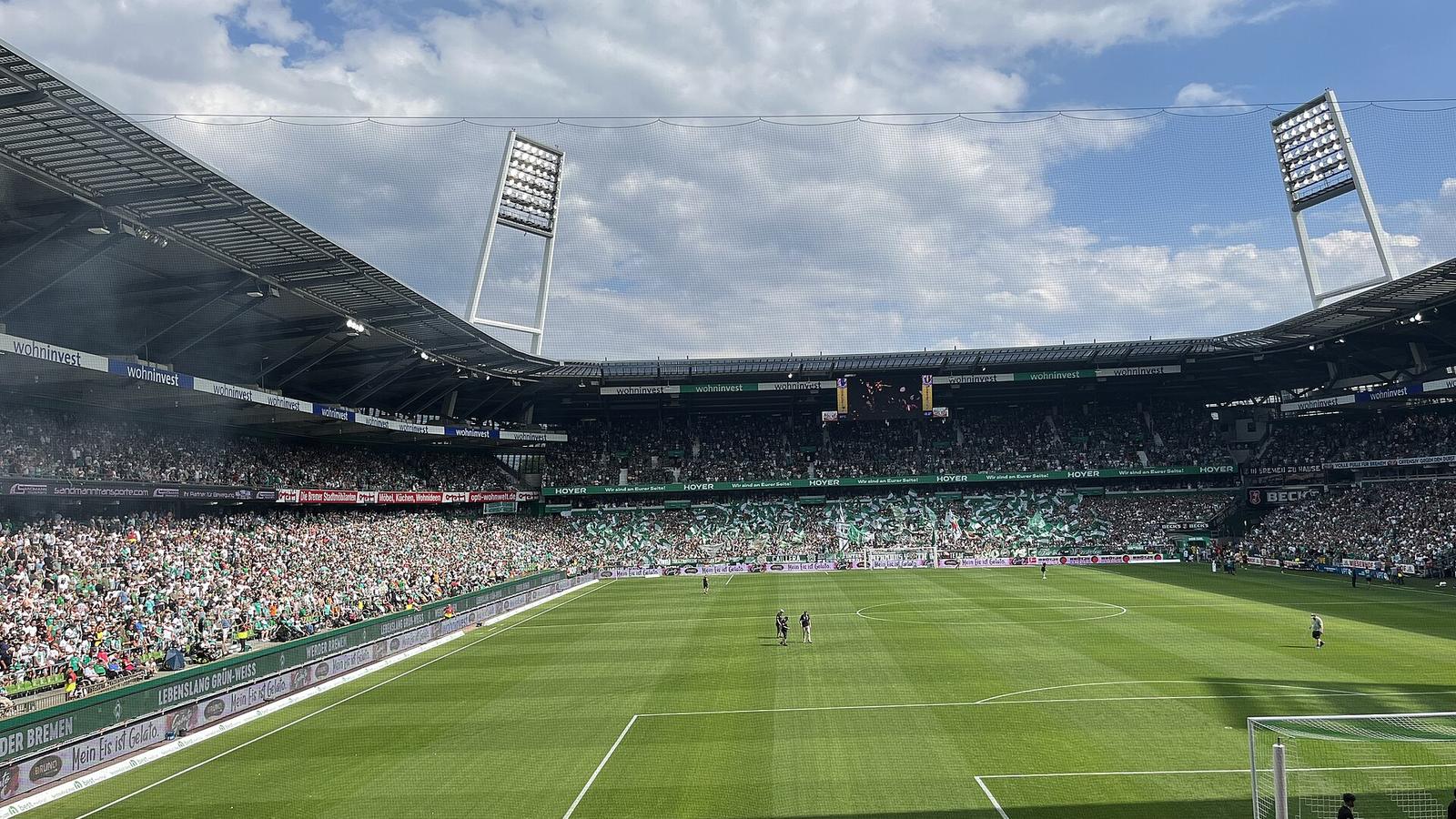
A disappointing season on the pitch, a positive result in the accounts
Eight wins, eight draws, eighteen defeats: Werder Bremen’s 2025/26 season fell short of its ambitions. With 32 points and fifteenth place, the club secured its place in the Bundesliga without achieving its goal of settling in mid-table. Only three points separated it from the relegation play-off spot.
A few months later, the accounts tell a different story. On 16 November 2026, the club announced a consolidated net profit of €2.1 million, compared with a loss of €7.4 million a year earlier. Revenue rose from €142.7 million to €154.2 million. In accounting terms, Werder therefore improved its result by €9.5 million during a testing season on the pitch.
To read this gap correctly, three notions that are often confused must be distinguished.
Sporting performance: 15th
The league position for the 2025/26 season.
Accounting performance: +€2.1m
Net income for the financial year ended 30 June 2026.
Financial strength: still to be shown
Equity, debt, cash and the ability to finance future seasons.
The first two are known. The third matters most to a club executive or an investor, and it is also the one the published information least allows us to judge.
| Indicator | 2024/25 | 2025/26 |
|---|---|---|
| Consolidated revenue | €142.7m | €154.2m |
| Operating expenses | €151.7m | €154.7m |
| Consolidated net income | −€7.4m | +€2.1m |
| Equity | €14.9m | €22.5m |
| Equity ratio | 15.8% | 18.8% |
These amounts alone do not allow consolidated net income to be reconstructed. Other items in the income statement are involved in its calculation. Their exact contribution needs to be examined in the detailed financial statements.
Revenue grew by about 8.1%, while operating expenses rose by almost 2.0%. The net margin is about 1.4%. This is a return to break-even, but not a margin large enough to conclude that the club is structurally and solidly profitable.
The role of transfers
The club attributes most of its revenue growth to higher income from player transfers. Its press release mentions in particular Mio Backhaus’s move to SC Freiburg, a club whose business model we have analysed. In this summary document, it does not disclose the consolidated amount of transfer income or its net contribution to the result.
Selling a player can support the accounts of a season in which sporting performance falls short. It is a coherent management choice, provided it does not become a recurring budget assumption: nothing guarantees that comparable opportunities will arise every year at the same price.
To measure what transfers really contributed, one would need to deduct the residual book value of the players sold, commissions and other transaction costs, and then see what is actually left in cash. Without this breakdown, the share of profit attributable to transfers cannot be measured.
Other revenue reflects the sporting season
According to Werder, ticketing and matchday, sponsorship, media rights and merchandising revenue declined overall. Elimination in the first round of the German Cup, compared with a run to the quarter-finals the previous season, weighed on income. The club also notes the absence of one-off revenue linked to Diego’s farewell match, held the previous year.
New hospitality areas and a better ranking in one of the components of the national media-rights distribution partly offset this decline. The conclusion stands: a difficult sporting season reduces the revenue a club can generate without selling players.
Costs under control, investment maintained
Werder states that personnel costs fell by €0.7 million, partly as a result of the first team’s results. At the same time, depreciation and amortisation rose by €3.6 million and transfer-related costs also increased by €3.6 million. The club continues to invest in its infrastructure and in women’s football.
The result therefore did not improve because the club stopped investing, but while it pursued certain structural commitments. It remains to be seen whether these investments will create enough sporting and economic value to justify their future costs.
The academy: an asset to be measured over time
Management highlights the progress of young players and their integration into the first team. An academy is not merely a cost centre: it can feed the professional squad, reduce some recruitment needs and allow valuable sales.
This strategy must, however, be judged over several seasons: how much does it cost to develop a generation, how many players actually reach the first team, and what share of income is reinvested in development and recruitment?
Stronger equity, and not only from profit
Consolidated equity rose from €14.9 million to €22.5 million. Werder announced a €4 million capital increase subscribed by WF12 GbR, whose stake now stands at 19.39%, as well as a €1.5 million contribution from the majority shareholder to the capital reserve.
The figures reconcile simply: €2.1 million of profit, a €4 million capital increase and a €1.5 million contribution to reserves add up to €7.6 million, the difference between the two equity levels. The equity ratio rose from 15.8% to 18.8%. This strengthening is real, but wealth generated by the business must be distinguished from funds contributed by shareholders.
Opening the capital without losing control: the 50+1 rule
The majority shareholder of the professional club remains the association Sport-Verein “Werder” von 1899 e.V., while WF12 holds 19.39% of the capital. This arrangement illustrates a specific feature of German football: the 50+1 rule.
The rule aims to preserve the member club’s majority of voting rights, not necessarily 50% of the capital in every structure. A German club can thus welcome private investors, who bring funds and sometimes expertise, while keeping control of decisions in the hands of the association and its members.
Opening the capital to minority investors buys time and resources. It does not replace the central question: in the medium term, can day-to-day operations finance the sporting project without regularly calling on outside contributions?
Sixth place today: an encouraging sign, not proof
As of 17 November 2026, after nine matchdays of the 2026/27 season, Werder sits sixth in the Bundesliga with 15 points. The contrast with fifteenth place the previous season is striking.
These two observations, however, relate to different periods. Accounts closed on 30 June 2026 do not prove that the current improvement stems from past financial decisions, and nine matchdays are not enough to conclude that the club has durably returned to the top of the table. The real question is whether the new financial structure will allow the club to keep its key players and remain competitive over time.
What a club executive can take away
The Werder case highlights three management requirements. First, draw up several budgets — a difficult fight against relegation, an average season, European qualification — each with realistic revenue and cost assumptions. Second, separate recurring profitability from player sales and capital contributions. Third, measure the return on investment in development, recruitment and infrastructure over several seasons.
Conclusion: the positive result is a starting point
Werder Bremen has shown that it is possible to improve its accounts significantly during a season in which the sporting objective was not achieved. This resilience rests on concrete choices: higher transfer income, contained expenses and stronger equity.
The profit nonetheless remains modest, and financial strength can only be assessed by reading the detailed consolidated accounts: debt, cash and room for manoeuvre over several financial years.
A poor sporting season does not necessarily mean poor financial management. But an accounting profit is not enough to show that a club has a sustainable business model either.
What you have learned
The key concepts of this analysis, explained simply. Click on a term to reveal its definition.
Accounting performance and financial strength
The first measures the result of a season; the second, a club’s ability to get through the following seasons thanks to its equity, its cash and controlled debt.
Equity
The residual book value of the club’s assets after deducting its debts and other liabilities. It includes in particular shareholders’ contributions and accumulated results.
Equity ratio
The share of equity in total assets. The higher it is, the less the club depends on its lenders.
Capital increase
The issue of new shares in exchange for fresh money contributed by an investor, whether new or existing.
Capital reserve
An equity item that records in particular share premiums — the part of the price of new shares above their nominal value — as well as certain shareholder contributions, with or without the issue of shares.
Amortisation of player contracts
The transfer fee paid for a player is spread in the accounts over the length of his contract, rather than recorded all at once.
Residual book value
The part of a player’s transfer fee that has not yet been amortised. It is deducted from the sale price to calculate the real gain on a transfer.
Transfer gain
The difference between a player’s sale price and his residual book value. It can sharply improve a season’s result, without being recurring.
50+1 rule
A German football rule that guarantees the member club a majority of voting rights in its professional company, even when investors come in.
Relegation play-off
The club finishing 16th in the Bundesliga plays a two-legged tie against the third-placed team in the second division to keep its place.
Independent study by Allioua Global Consulting based on public sources available as of 17 November 2026. Werder Bremen is not presented as a client, partner or sponsor of this analysis. Ratios are rounded AGC calculations. The audited consolidated accounts at 30 June 2026 were not consulted directly; debt and cash items are therefore not asserted. This analysis constitutes neither investment advice nor a financial audit.