
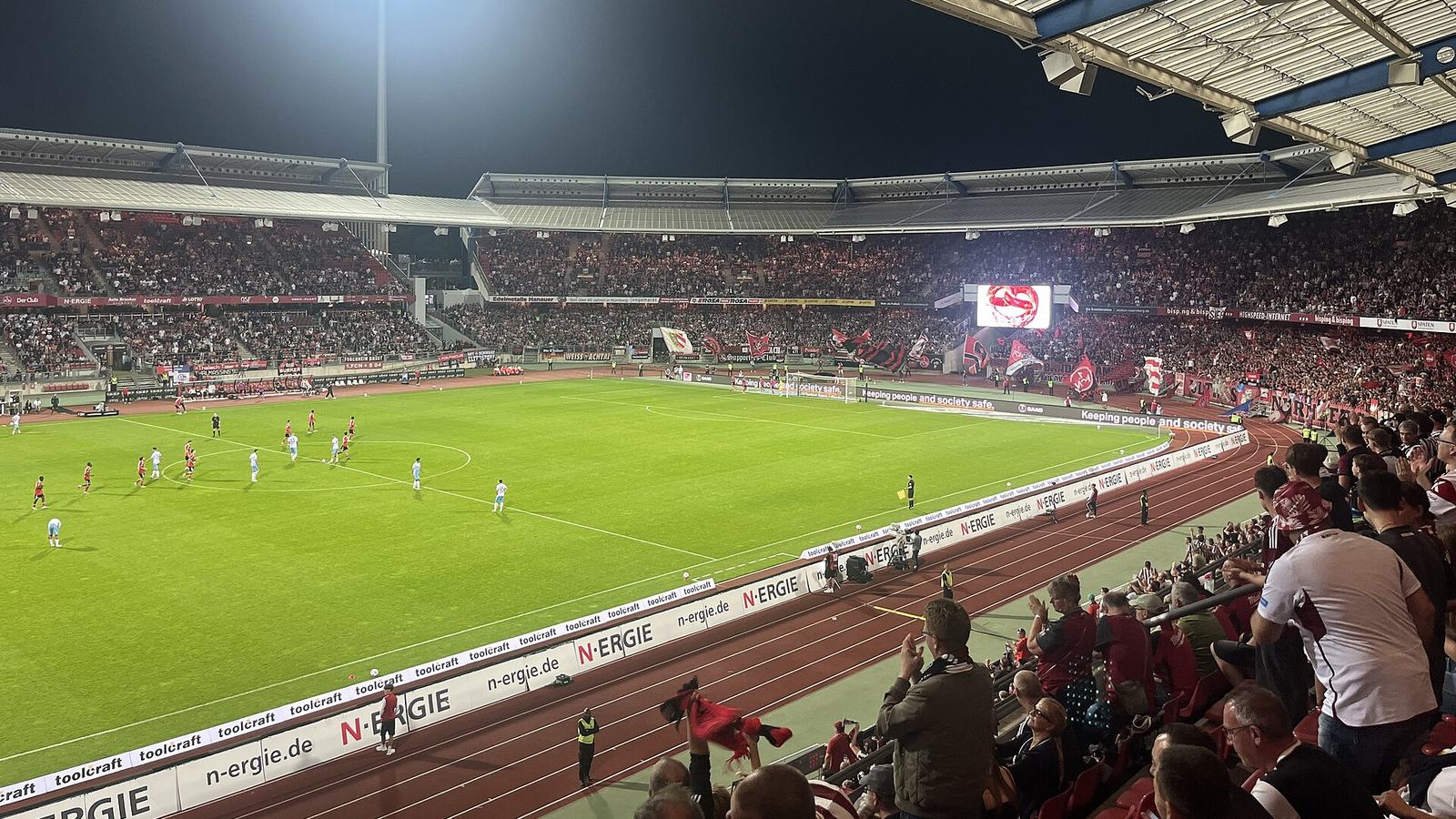
Financial stability as a prerequisite for sporting ambition
Professional football often gives the impression that growing means spending more: signing players, raising the wage bill, modernising facilities, then hoping that sporting progress will pay for the investments made. 1. FC Nürnberg offers a different perspective. This historic club, now competing in Germany’s second division, is seeking to improve its results while rebuilding its financial room for manoeuvre.
The accounts announced on 17 November 2026 show a consolidated profit of €1.5 million for the 2025/26 financial year. This result comes as group income fell by almost 30%, mainly because of lower transfer revenue. Management also highlights growth in commercial revenue, the repayment of loans and a reduction in what it calls the “structural” deficit.
Consolidated profit: +€1.5m
2025/26 financial year, ended 30 June 2026.
Group income: €73.8m
Compared with €105.3m in 2024/25.
Consolidated equity: €7.2m
Compared with €5.7m a year earlier.
A sporting situation that sheds light on the economic project
Nürnberg finished the 2025/26 season eighth in the 2. Bundesliga, with 46 points. As of 18 November 2026, the latest official table places the club second, with 24 points after eleven matchdays. This is an encouraging indicator, but it would be unwise to attribute this provisional ranking solely to the club’s financial decisions.
This gap between one season’s financial result and the ambitions of the next is essential. Sound economic management guarantees neither a league position nor promotion. It can, however, give the club the ability to anticipate its sporting needs, invest in its squad and turn down certain transfer offers when they do not fit its strategy.
A profitable year does not mean that the business model is fully balanced: reducing the structural deficit and consolidating recurring revenue remain essential.
Falling income, a result still in profit
The table below covers consolidated data, that is, the association and its subsidiaries, not the association alone. The distinction matters: group equity stands at €7.2 million, while that of 1. FC Nürnberg e.V. amounts to €12.0 million.
| Indicator | 2024/25 | 2025/26 | Change |
|---|---|---|---|
| Consolidated income | €105.3m | €73.8m | −29.9% |
| Consolidated expenses | €92.2m | €72.3m | −21.6% |
| Consolidated result | +€13.1m | +€1.5m | −€11.6m |
| Transfer revenue* | €52.4m | €19.5m | −62.8% |
| Commercial / distribution revenue | €33.3m | €34.4m | +3.3% |
| Consolidated equity | €5.7m | €7.2m | +€1.5m |
| Equity of the association (e.V.) | €10.5m | €12.0m | +€1.5m |
Less relative dependence on player sales
Transfer revenue accounted for about 49.8% of consolidated income in 2024/25, compared with at least 26.4% in 2025/26 if the announced figure of more than €19.5 million is set against total income of €73.8 million. The proportion has fallen sharply, but it remains significant.
This change is encouraging without proving that the model is self-sufficient. Not all sale proceeds are a net economic gain: the book value of the players sold, fees paid earlier, commissions and other related costs must be taken into account. The club also states that transfer-related expenses fell between the two financial years.
What does the €2.2m “structural deficit” mean?
Management says it has reduced this indicator from an initial level close to €5 million, then above €3 million, to €2.2 million. The press releases examined do not, however, publish its detailed calculation. It should therefore be presented as an indicator declared by the club, not as a balance that can be fully reconstructed.
Simply subtracting the announced transfer revenue from consolidated income and comparing the result with total expenses would give a gross gap of around −€18 million. This calculation does not measure the structural deficit: it removes income without neutralising transfer-related expenses or other necessary reclassifications. It would be wrong to equate the two figures.
The increase in consolidated equity matches the year’s profit (+€1.5m); only the detailed accounts could confirm that no other movement occurred.
An accounting result that gives the club back its freedom
Nürnberg’s profit remains modest. Relative to consolidated income, it represents a margin of about 2.0% for 2025/26. The €7.2 million of consolidated equity provides a positive base, but a small one in absolute terms given the volume of activity. Without total assets or net debt figures, it is not possible to calculate an equity ratio here or to conclude that the club is durably solvent.
Chief financial officer Stefan Heim explains that the club was able to repay loans and preserve its ability to borrow again. No precise amount of debt repaid is given in the communications consulted. This point is decisive: the model presented is not about rejecting debt, but about regaining the freedom to choose when and why to use it.
Management illustrates this new room for manoeuvre with a sporting decision: it says it was able to turn down an offer considered attractive for Mohamed Ali Zoma. The exact significance of this decision cannot be quantified from the press release, but it sheds light on the club’s reasoning: less constrained cash can make it possible to avoid a forced sale.
This discipline also operates within the DFL licensing framework, which checks every season clubs’ economic capacity to finance their activity and provides for checks during the year. The system requires a review of viability; on its own, however, it does not guarantee the absence of financial risk.
The Max-Morlock-Stadion: from expense to economic asset
The development of the stadium complements this strategy. On 22 July 2026, the city council approved further development of a full redevelopment option for the Max-Morlock-Stadion: around 50,000 seats, stands brought closer to the pitch, improved accessibility and expanded hospitality areas. The city also plans more diversified use, particularly for major events. This is a planning stage, not a final building permit or an approved business plan.
The economic objective is clear: to increase the infrastructure’s capacity to generate regular revenue beyond matchdays alone. The club’s management cites a gap of up to €8.8 million in annual hospitality revenue compared with certain benchmark clubs. This figure is a benchmark put forward by the club, not a forecast of an increase in its own revenue.
The other side of the equation must be examined at the same time: operating costs, maintenance, financing, construction schedule and any revenue lost during the redevelopment. The city has announced that a business plan and a financing concept must be developed further with the club and the State of Bavaria before final decisions are taken.
An infrastructure only creates value if the additional revenue it generates durably exceeds all the costs and risks it creates.
The cooperative: turning attachment to the club into financing capacity
On 17 November 2026, Nürnberg presented a crowdfunding option in the form of a Genossenschaft, a cooperative whose members could subscribe to shares and take part in certain decisions. The proposed principle is one vote per member, regardless of the amount invested.
€15m
Contribution initially planned by the club.
€30m
Contribution target revised upwards.
+€15m
Targeted difference, not yet raised.
This is therefore neither a completed fundraising nor the total cost of the stadium. The club wants to increase from €15 million to €30 million the liquid funds it could contribute to the project, notably through the cooperative mechanism. This assumption remains subject to two conditions: the transfer of the future stadium’s operation to the club and the cooperative’s participation in the operating company.
A measurable precedent: FC St. Pauli
The model echoes the experience of FC St. Pauli. In May 2025, the Hamburg club announced 22,623 members and around €29.18 million of shares subscribed in its cooperative, or almost €1,290 of subscriptions per member on average (AGC calculation). This is an arithmetic average: each member could subscribe to a different number of shares.
This reference shows that a sporting community can become an organised financial resource. It is not, however, a guarantee of success for Nürnberg: take-up will depend on the subscription terms, any return, withdrawal conditions and confidence in the project.
Why this approach is not opposed to borrowing
The city explicitly plans to finance part of the future stadium’s investment with borrowed capital, in addition to public contributions and those of the club. According to earlier municipal assessments, the project’s viability depends on the operating revenue assumed in the scenarios; the city has also acknowledged that some initial ticketing estimates may have been too optimistic.
The cooperative could therefore reduce the need for external debt, without necessarily eliminating it. It would diversify the providers of funds while seeking governance compatible with the club’s member-based identity. The central question becomes the real economic cost of each source of financing and the allocation of risks between the city, the club, cooperative members and lenders.
A promising model, still to be proven
The first risk is operational. Nürnberg remains dependent on significant transfers and reports a structural deficit that has not yet been eliminated. A season with fewer sales and higher sporting costs could quickly reduce the surplus seen in 2025/26.
The second risk concerns property and financing. The final cost of the works, the terms of external financing, hospitality revenue and the schedule remain to be specified. The future stadium’s operating model cannot be assessed independently of the financial commitments that will be attached to it. Optimistic revenue projections must not turn into certain costs.
The third risk lies in the governance of the cooperative structure. Broader participation can strengthen support for the project, but it requires clear rules: members’ rights, allocation of funds, handling of any withdrawal requests, representation within the operating company and protection of the club’s day-to-day finances.
What executives at other clubs can take away
01 — Separate revenue streams
Distinguish recurring revenue from player sales and one-off events before setting spending commitments.
02 — Stay in control of risk
Test several operating and financing scenarios, particularly in the event of a disappointing sporting season.
03 — Broaden resources
Bring together supporters, public partners and private funders without making the club dependent on a single provider.
Conclusion: investing without mortgaging the next season
1. FC Nürnberg does not show that a second-division club can finance its growth without debt. It reveals something more useful: management can seek to organise its financing before accelerating its investment, protecting its decision-making capacity and involving its community in long-term projects.
The profit, the growth in equity and the lower relative share of transfers are signs of consolidation, not proof of financial independence. The stadium and its cooperative are a conceptually credible path to development, whose success will depend on economic, legal and operational conditions still to be defined.
A club’s success is not measured only by what it can invest today, but also by the capacity for action it will have left when sporting results or revenue are less favourable.
What you have learned
The key concepts of this analysis, explained simply. Click on a term to reveal its definition.
Cooperative (Genossenschaft)
An organisation in which members pool funds to develop a project, with governance rights defined by its articles of association.
One vote per member
A democratic governance principle: voting power does not depend on the number of shares held, subject to the applicable rules.
Structural deficit
An indicator of recurring imbalance, whose scope depends on a precise definition. Here, the formula used by the club is not published.
Equity
The residual book value belonging to the entity after deducting its debts; not to be confused with cash or revenue.
DFL licence
A process checking the conditions for participation, including economic, organisational and sporting requirements for professional clubs.
Operating company
The entity responsible for managing a stadium and organising its contractual and commercial operation.
Hospitality
Revenue from VIP and corporate areas, hosting services and premium commercial offers at the stadium.
Debt financing
Borrowed capital that must be repaid, with debt service to be borne regardless of sporting results.
Transfer revenue
Income from selling players’ registration rights; it does not necessarily correspond to the net gain.
Consolidated / e.V. equity
The former covers the group and its subsidiaries; the latter only the association. The amounts can differ.
Independent analysis by Allioua Global Consulting based on public communications and data available as of 18 November 2026. 1. FC Nürnberg, FC St. Pauli and the other clubs mentioned are not presented as clients of the firm. AGC calculations are rounded; the detailed audited accounts, the final stadium financing plan and the articles of any cooperative have not been examined. This analysis is neither an audit nor an investment recommendation.
Sources
- 1. FC Nürnberg — Wirtschaftsbericht 25/26: Club verzeichnet positives Jahresergebnis (17 November 2026)
- 1. FC Nürnberg — Die wichtigsten Aussagen der Vorstände (17 November 2026)
- 1. FC Nürnberg — Genossenschaft soll helfen: Füreinander fürs neue Achteck (17 November 2026)
- City of Nuremberg — Das neue Achteck: Stadtrat beschließt Vorzugsvariante (22 July 2026)
- City of Nuremberg — Zukunft Stadionareal: operating model and financing
- DFB Datencenter — 2. Bundesliga 2025/26, final table (matchday 34)
- 1. FC Nürnberg — 2. Bundesliga 2026/27 table (consulted on 18 November 2026)
- 1. FC Nürnberg — Wirtschaftsbericht 24/25: Club verkündet Rekordjahr (18 November 2025)
- NDR — FC St. Pauli: Genossenschaft nimmt mehr als 29 Millionen Euro ein (8 May 2025)
- DFL — Lizenzierungsordnung, § 8 and § 8a: financial criteria (version of 21 April 2026)